I finally finished the "By the Decades" Challenge hosted by 1 More Chapter. Here's the list of what I read with links to the reviews:
1860's - The Moonstone by Wilkie Collins
1870's - Daniel Deronda by George Eliot
1880's - Dr. Jekyll and Mr. Hyde by Stevenson
1890's - The Turn of the Screw by Henry James
1900's - The House of Mirth by Edith Wharton
1910's - Sons and Lovers by D.H. Lawrence
1920's - Death Comes for the Archbishop by Willa Cather
1930's - As I Lay Dying by William Faulkner
My favorites were Daniel Deronda and The House of Mirth. I could have done without Sons and Lovers. I am tempted to participate in this challenge for 2009 and tackle some other decades!
Showing posts with label By the Decades Reading Challenge. Show all posts
Showing posts with label By the Decades Reading Challenge. Show all posts
Wednesday, November 12, 2008


Tuesday, November 11, 2008
Daniel Deronda

Author: George Eliot
Originally published: 1876
This edition published by: Modern Library (2002)
Introduction by: Edmund White
Length: 800 pagesThis edition published by: Modern Library (2002)
Introduction by: Edmund White
My Rating: 4.5/5
While George Eliot is one of my favorite authors, I have to admit that the first 250 pages of Daniel Deronda were rather like swimming against the current. A couple of things I enjoy about her writing are her in-depth characterizations and her digressions into topics that I personally obsess about, but even these aspects became tedious to me. There are some minor characters that the reader simply does not need to know so much about! Ironically, she makes this statement after introducing the enigmatic Grandcourt: "Attempts at description are stupid: who can all at once describe a human being?" Well, in my opinion, Eliot is pretty darn good at it, even though she goes a bit overboard in the beginning. However, once she has established the psychological framework of everyone under the sun, the story does pick up and the book gets hard to put down (despite its weight!)
Here is a brief summary a la back of the book:
Here is a brief summary a la back of the book:
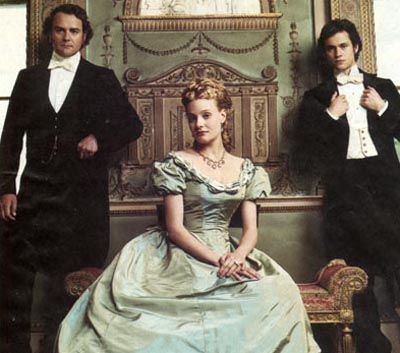
George Eliot's final novel and her most ambitious work, Daniel Deronda contrasts the moral laxity of the British aristocracy with the dedicated fervor of Jewish nationalists. Crushed by a loveless marriage to the cruel and arrogant Grandcourt, Gwendolyn Harleth seeks salvation in the deeply spiritual and altruistic Daniel Deronda. But Deronda, profoundly affected by the discovery of his Jewish ancestry, is ultimately too committed to his own cultural awakening to save Gwendolyn from despair.
This brief description barely scratches the surface of what is to me a very deep and complex novel that I could not even begin to summarize myself. The biggest question I had while reading it was "Why isn't the book titled 'Gwendolyn' rather than 'Daniel Deronda?'" Even though Deronda goes through a major cultural and religious conversion, he is still very much the same person from beginning to end--a deeply empathetic man with a desire to be a savior to all in need. It is Gwendolyn who changes from a self-centered girl who "did not like to dwell on facts which threw an unfavorable light on herself" to a woman who must in the end face the ugliest aspects of her personality. I can't help but wonder if Eliot created this misnomer by design--after all, she herself changed her name many times throughout her life. Also interesting to note--Gwendoylyn is the only main character in the novel who goes by her given name (other than when she marries). All of the others have at some point in their lives taken on different names than those given at birth. If this was indeed intentional, what was she trying to convey? Perhaps that regardless of the names we choose to take upon ourselves, out identity is based on something more substantial than a name?
The most powerful theme of the novel (among many) is the fact of life that often our gain is another's loss, and when we help one person, we may be causing another to suffer. All of the major characters (except for the cruel but flat Grandcourt), grapple with this truth and attempt to come to terms with it. Deronda must admit that he can't save everyone, and Gwendolyn must accept that even is she is on the losing side, she is capable of picking up the pieces and making a life for herself.
Really, I could go on and on with my thoughts on this novel. The plot may seem to get drowned a bit in the characterizations and the psychological musings. It also may have a touch of flowery romantic melodrama: "You are to me the chief woman in the world--the throned lady whose colours I carry between my heart and my armour." And certain elements of the plot are somewhat coincidental. But I still loved it; I am partial to George Eliot. This is the fifth novel of hers that I have read, Middlemarch being my favorite, with Adam Bede a close second. I know it's not for everyone, and if you don't feel up to perservering through 800 pages, watch the BBC movie. It's excellent. I haven't seen it for a few years, but I think it follows the plot fairly well. Luckily, I had forgotten the ending completely, so the book held a few surpises for me!
The most powerful theme of the novel (among many) is the fact of life that often our gain is another's loss, and when we help one person, we may be causing another to suffer. All of the major characters (except for the cruel but flat Grandcourt), grapple with this truth and attempt to come to terms with it. Deronda must admit that he can't save everyone, and Gwendolyn must accept that even is she is on the losing side, she is capable of picking up the pieces and making a life for herself.
Really, I could go on and on with my thoughts on this novel. The plot may seem to get drowned a bit in the characterizations and the psychological musings. It also may have a touch of flowery romantic melodrama: "You are to me the chief woman in the world--the throned lady whose colours I carry between my heart and my armour." And certain elements of the plot are somewhat coincidental. But I still loved it; I am partial to George Eliot. This is the fifth novel of hers that I have read, Middlemarch being my favorite, with Adam Bede a close second. I know it's not for everyone, and if you don't feel up to perservering through 800 pages, watch the BBC movie. It's excellent. I haven't seen it for a few years, but I think it follows the plot fairly well. Luckily, I had forgotten the ending completely, so the book held a few surpises for me!
Thursday, July 24, 2008
The House of Mirth by Edith Wharton
 Lily Bart lives in a world where society is constantly evaluating its members to determine if they are still worthy. A part of Lily wants to detach herself from it, but her perception of herself is so dependent on her social status that she never seems to be able to break away. When her actions banish her from her social group, Lily is forced to join the middle class and live with the "dinginess" she so abhors.
If Lily could just marry someone rich, her social and material success would be assured. But she repeatedly sabotages her chances for marriage. Lawrence Seldon, a friend of Lily's and a detached observer of her high society life, is a constant distraction for her. Does she love him? Can she live the kind of life he would provide for her? I don't know for sure if she loves him, but can't be with him because he is part of a different world, or if her attraction to him is just another manifestation of her indecision. Ultimately, she can never really choose either world, with tragic results.
I enjoy a wide variety of books, but this is the kind of novel that makes me passionate about reading. It is rich with characterization, the story is gripping, the writing is beautiful and precise.
Rating: 5/5
Monday, April 7, 2008
The Turn of the Screw by Henry James (1898, 116 pgs.)
 I sort of had a love-hate relationship with this book. It is my first Henry James work, and it was not at all what I expected it to be. The story is basically about a young woman who accepts a position as governess for two small children, Miles and Flora. Having lost their parents, their uncle is responsible for them, but keeps his distance, and has asked the governess (I can't even recall her name and can't find it skimming through the book--I think she is only addressed as "Miss.") to never bother him with any troubles or questions. "Miss ?" settles in happily at first, daydreaming of pleasing the Uncle who is a handsome bachelor, but soon begins to see a couple of ghosts. At first, the story was a bit annoying--the governess has an inflated sense of herself and her role, unrealistically idealizes the two children, and is obsessed with pleasing the uncle who she only met for a short time. But then I began to think that this was the author's design--I began to wonder if there really were ghosts, or if the governess is mentally ill, and is just hallucinating. Most of the story is told by the governess, and she always seems a just a bit removed from sanity. There were parts that I couldn't follow, and I couldn't decide if that was because she was mentally ill, or if it was because I was mentally unable!
Just finishing this I am left with so many questions. Were there really ghosts, or are they a figment of her imagination? Was James trying to say something about appearances and their exaggerated importance in Victorian society? At times I wondered if the ghosts represented the evil within that the children would eventually have to succumb to as they grew up. At one point it seemed to me like the reader was to infer that the children had been molested, and that the boy, who had been sent home from school for an unknown offense, had committed some deviant act. Or maybe, since this was in Victorian times, they were just minor offenses that were considered very inappropriate at the time. The bottom line is, "I don't know!"
This was the selection for my wonderful library's classics book club, and was one I had chosen for a reading challenge. I can't actually go to the discussion, which starts in about 15 minutes, but I would have loved to find out some other thoughts on all of these questions from the other readers. For now, I will just question and wonder (or pay a visit to Wikipedia!). Sometimes I think that that is what makes some classics last--unanswered questions that can be debated for decades!
This was the selection for my wonderful library's classics book club, and was one I had chosen for a reading challenge. I can't actually go to the discussion, which starts in about 15 minutes, but I would have loved to find out some other thoughts on all of these questions from the other readers. For now, I will just question and wonder (or pay a visit to Wikipedia!). Sometimes I think that that is what makes some classics last--unanswered questions that can be debated for decades!
Wednesday, January 30, 2008
The Moonstone by Wilkie Collins (1868, 526 pgs.)
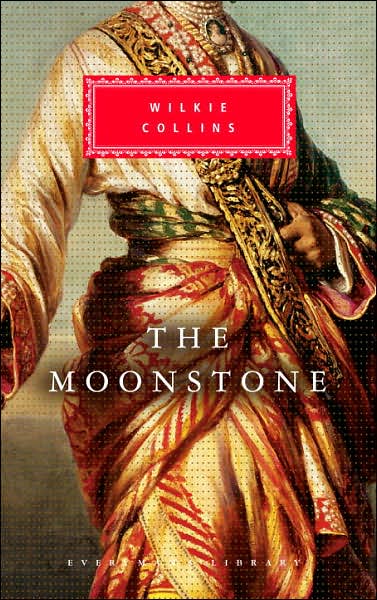 I had absolutely no idea what to expect from this novel; the only thing familiar to me was the name. Most surprising to me was how easy it was to read. It is basically a British detective story in which the Moonstone, a valuable diamond stolen from a sacred shrine in India, is given as a gift to Rachel Verinder, only to have it stolen from her. The plot unfolds very slowly at first, but is tolerable due to the comical voice of a couple of the narrators. The book consists of several letters written by the characters to sort out all of the events and evidence surrounding the theft in an effort to discover who is guilty. The first and funniest is Gabriel Betteredge, the head servant of the Verinder household, who uses his worn copy of Robinson Crusoe for inspiration and guidance.
He says:
"I have found it my friend in need in all the necessities of this mortal life. When my spirits are bad--Robinson Crusoe. When I want advice--Robinson Crusoe. In past times, when my wife plagued me--Robinson Crusoe. "
The second narrator, Mrs. Clack, the self-righteous cousin of Rachel Verinder, forces upon "perishing fellow creatures" her religious tracts--The Serpent at Home, Satan in the Hairbrush, Satan out of the Window, etc. She even goes so far as to deposit the tracts into Lady Verinder's flower pots, the bird cage, the piano, a fan, the bed--anywhere they might be discovered and lead to a much needed conversion. (I kept picturing Angela from The Office during her section.)
The following narrators were not nearly as entertaining, and the last 100 pages or so kind of dragged for me, but all in all I enjoyed it. It is considered the original modern detective story, if that's a draw for anyone. It's always fun to experience the birth of a genre!

Thursday, January 17, 2008
As I Lay Dying by William Faulkner
 I haven't done a four-word review in a while, so here's one for As I Lay Dying:
Dysfunctional Family Buries Mother
I can't quite leave it at that--I liked it better than The Sound and the Fury, but you still have to work at understanding some passages, and switch gears often due to the many narrators. In some parts I laughed, and others pondered the meaning of my existence, like the characters in the novel. If I were to read this in an American Lit class, where I would have to dissect it and dig deeper, I bet it would earn one more star. But for now:

Friday, January 4, 2008
Dr. Jekyll and Mr. Hyde by Robert Louis Stevenson
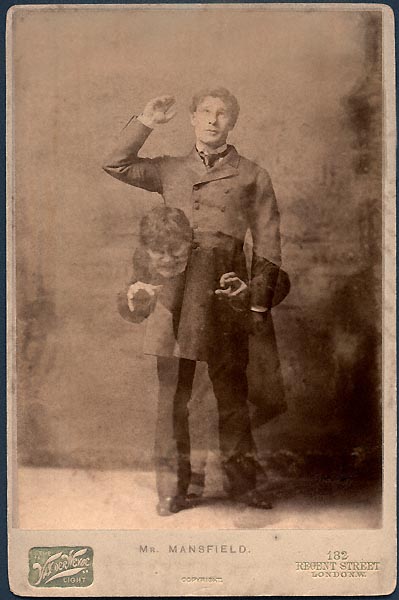 It seems only appropriate that I should read this book, seeing that it is the name I have for my most common parenting style--kind, gentle, and loving most of the time, until I unleash the irrational, hormonal beast from within, usually provoked by innocent infractions such as stickiness on the floor, or the latest chemistry experiment in the bathroom sink. I thought maybe I could pick up a few more tips from the expert(s) . . .
Our first glimpse of Mr. Hyde is a scene in which he viciously tramples an innocent young child (okay, before you think of calling Child Protective Services, let me tell you I have not gone this far!) Thanks to popular culture, we already know that Mr. Hyde is Dr. Jekyll's amoral alter-ego, so the mystery aspect of the book is lost. I can only envy the early readers of the novel who didn't know until the end of the story that the two are the same being. However, knowing the end does not lessen the impact of the age-old theme of the good and evil residing simultaneously within us--"man is not truly one, but truly two." Dr. Jekyll comes to "dwell on the thought of the separation of these elements. If each, I told myself, could be housed in separate identities, life would be relieved of all that was unbearable; the unjust might go his way. . . and the just could walk steadfastly and securely on his upward path . . . no longer exposed to disgrace and penitence by the hands of this extraneous evil." Pick up a copy of Dr. Jekyll and Mr. Hyde to find out how wrong he was--or, like me, to pick up some new parenting how-to's.

Subscribe to:
Posts (Atom)