Showing posts with label Audio Book. Show all posts

Thursday, November 6, 2008

Weekly Geeks #23 - Better Late Than Never


This week we are to pick any of the previous assignments and choose one. Since I am behind on reviews (what else is new?), I figured I would do some catch up with that. (I'm not sure what number it was.) And of course I have come up with a rather lazy way of doing so: No sentences allowed. Just think of it this way--readers will spend less time reading this post and have more time to read those books on their neverending TBR lists!

Inkheart by Cornelia Funke
560 pages
My rating: 4.5/5
Summary: Meggie's father has ability to read characters out of books, some of them evil, and tragically reads Meggie's mother into a book. Struggle to keep evil characters from doing more harm and seek to create a happy ending.
Review: likable, interesting characters; great tribute to the love of literature; not super dynamic but captivating story; made me feel good; beautiful setting; definitely want to read sequels.

Sign of the Beaver by Elizabeth George Speare
(Audio)
My rating: 3/5
Summary: 13-year-old Matt left in the wilderness of Maine in the late 1700's while father goes back for family.
Review: Didn't hold my attention; didn't even realize that I listened to Disc 3 before Disc 2 (oops!); wonder if I would have liked it better read than listened too; loved The Witch of Blackbird Pond by Speare, liked The Bronze Bow, ho hum about this one.

The Sister's Grimm: The Fairy Tale Detectives by Michael Buckley
(304 pages)
My Rating: 4/5

Summary: Sabrina and Daphne's parents disappear; move in with grandma in Ferryport Landing; they learn, but don't necessarily believe they are descended from the Grimm storytellers; get involved in solving a mystery involving Prince Charming and the Three Pigs.
Review: Read this with 9-year-old daughter and loved it; laugh-out-loud funny at times; creative story-telling.

Dragon Rider by Cornelia Funke
(Audio)
My Rating: 4/5
Summary: Dragons must find a new home in the Himalayas; led by noble dragon named Firedrake; helped by a colorful cast of characters; challenged by power-hungry sorcerer/dragon.
Review: Lots of good/quirky characters that have good hearts; loved the geography of it; great narration by Brendan Fraser; perfect for a family road trip!

Creepers by Joanne Dahme
232 pages
My Rating: 3/5
Summary: 13-year-old Courtney moves into house next to a cemetery; both overrun by out-of-control ivy; with eccentric neighbors, Courtney to solve the mystery of an ancestor's missing body.
Review: Beautiful cover and illustrations; a little creepy but not too much for babies like myself; quick and fun read.

I think technically I may have used a couple of sentences. Oh well, if I make the rules I can break them too, right?

There are a couple of books I haven't covered yet: Daniel Deronda (it deserves sentences, even my sloppy ones) and The Lightning Thief (which I will probably have my son do).


Tuesday, October 28, 2008

Queen of Scots: The True Life of Mary Stuart


Author: John Guy
Narrator: John Guy
Published by: Harper Collins Publishers (2004)
Length: 6 hours (abridged)
My Rating: 4/5

History is both fascinating and forgettable for me. I love to read or listen to history books, but my retention of facts is minimal. Sometimes I wonder why I even bother--I'm certainly not entertaining any notions of scholarliness. What it boils down to is entertainment, and the life of Mary, Queen of Scots could never be described as boring. I knew before listening to this book some of the well-known facts about Mary, particularly her gruesome execution. But here are some examples of the utterly unscholarly facts that I have managed to remember:

  • When Mary gave birth to her first baby, she said, "If I had known it would hurt this bad, I would never have gotten married." (Amen, sister!)
  • She had a few enemas to treat various illnesses. (Do you think she wanted us all to know about them?)
  • When she was imprisoned, what she longed for most was exercise and she ate too much. (I can relate to this.)
  • She was tall. (I can't relate to this.)
So, while I may not be increasing my chances of getting on Jeopardy, or slamming my opponents at Trivial Pursuit, I will still read history and non-fiction because it's just plain interesting. This was a great audio-book to listen to, and with fiction about royalty being so popular, it would be a great companion to any story about Mary Stuart. Hopefully other readers will remember more significant details than I have, but if not, just remember--no history tests!


Saturday, October 25, 2008

A Crooked Kind of Perfect


Author: Linda Urban
Narrator: Tai Alexandra Ricci
Published by: Listening Library (Audio) Sept. 2007
Length: 3 hours 17 minutes
My Rating: 4.5/5

Doesn't the cover just make you want to read this book? In this case, you can judge a book by it's cover. Eleven-year-old Zoe dreams of playing the piano at Carnegie Hall, but must settle for sharing her talents at the "Perfectone Perform-o-rama," performing a Neil Diamond song. Between a father with social anxiety and a mother who works too much, Zoe's life does not always live up to her ideals. But she manages to recognize their love and do her best at the performance.

This was a quick "listen," and I thought the narration was perfect. With it's feel-good humor, I enjoyed this children's book as an adult, and plan to pass it on to my 9-year-old daughter as well, who I think will love it.

Friday, October 24, 2008

Blessings


Author: Anna Quindlen
Narrator: Joan Allen
Published by: Random House Audio (Sept. 2002)
Length: 7 hours, 45 minutes
My rating: 3/5

Although I must admit that this is a somewhat forgettable story, I felt that it was well-written and heart-warming. The narrator, Joan Allen was perfect, and it was very easy to listen to. I also must admit that the reason I picked this one was for the valuable "Q" of Quindlen which helped me fill a requirement for the A to Z Reading Challenge. Otherwise it's not really one that would draw my attention.

The story begins as a young couple leaves a newborn baby at the Blessings estate, where Lydia Blessing, an 80-year-old miserly recluse lives. Skip Cuddy, the handyman that lives over the garage, discovers the infant first, and secretly takes on the role as the infant's father, learning through trial and error the ins and outs of baby care. Lydia soon discovers the Skip's secret and becomes a partner in trying to provide the baby with a secure future.

As the story unfolds, we learn about Lydia's past and why she lives such a solitary life, and we get insight into why Skip, and ex-con would even consider taking on the responsibility of a baby. I found this premise of the story slightly unbelievable, but that may just be from the limits of my own experience.

On a personal level, this book reminded me of how challenging yet rewarding taking care of an infant can be. Likewise, I think a main theme of this book is that fulfilling relationships take work, they don't just happen, and we never know how short or long of a time we will have to enjoy them.

Monday, October 6, 2008

September: Seven-Word Reviews


I'm so proud of myself that I was able to control my reading a bit this month! I'm trying to think of what I accomplished with that extra time but my mind is a blank. I'm sure I did something productive . . .
Of September's books, two were audio books, two were children's books, and one non-fiction. My favorite of these, In Defense of Food, is known for its simple seven words of advice for healthy eating: EAT FOOD. NOT TOO MUCH. MOSTLY PLANTS. In honor of this wise brevity, I'm going to attempt some seven-word-(ish) summaries of my own. And since seven words doesn't really say a whole lot about a book, I've linked each one to its Amazon page if you want to know more about it.

**Also, if anyone has reviewed any of these books, I would love to add a link of your review to this post.**

Suite Francaise by Irene Nemirovsky: (Audio book)
MAN'S INHUMANITY EXPOSED IN UNFINISHED WWII ACCOUNT
For another review, visit:
Jules' Book Reviews

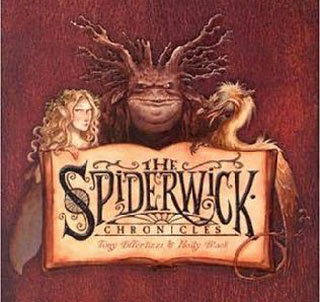
The Spiderwick Chronicles series by Tony DiTerlizzi and Holly Black (Read-aloud)
ONE STORY DIVIDED BY FIVE: CHA-CHING!

Presidential Races by Arlene Morris-Lipsman (Children's book, read-aloud til kids got bored)
FROM FRONT-PORCH CAMPAIGNS TO YOU TUBE

Wee Free Men by Terry Pratchett (Audio book, YA)
CHEESE-MAKING WITCH SAVES BROTHER IN ZANY FANTASY

In Defense of Food: An Eater's Manifesto by Michael Pollan (Non-fiction)
REALIZATION: BEEN EATING FAKE FOOD SINCE BIRTH

Wednesday, June 25, 2008

Audio Book:Mrs. Piggle-Wiggle by Betty MacDonald


Four-word Review:

Kid's entertainment, parent's therapy.

Rating: 5 Stars

Monday, May 19, 2008

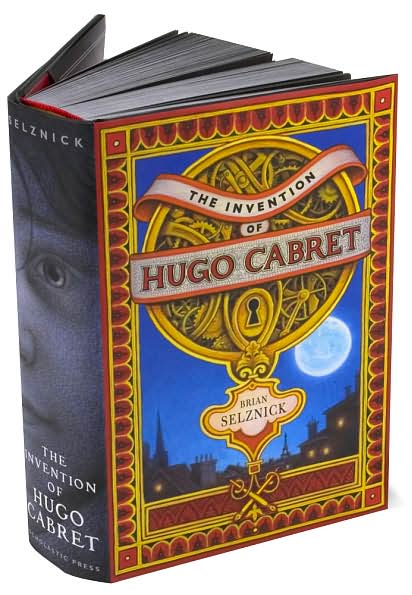
Audiobook: The Invention of Hugo Cabret by Brian Selznick (2007, 2 hrs., 52 min.)

Those familiar with this book will probably wonder "Why the heck did they listen to a Caldecott winner?" Well, the answer is, I didn't know that it was, despite my son repeatedly telling me that he had heard the pictures were really cool. Once we checked out the book at the library, I realized just what we were missing out on. But we did listen to the whole thing, which was excellently narrated and has a strong enough story to stand on its own. I have asked Anna (9) and Jeremy (11) to write their thoughts on this unique novel:

Anna:
The story is about an 11-year old orphan named Hugo Cabret that works on an invention called automaton. Hugo steals from a man that works at a toy booth to get stuff to build the automaton.On his way to get stuff, Hugo meets a girl who sort of helps him. I think this story is for boys and girls. I thought that it was a good book and it contains lots of detail.

Jeremy:

If I had to give Hugo Cabret a rating from 1 to 5, I would give it a 4.5. It is a book with a good plot and it is suspenseful at times. My favorite part was the part where the Automaton was drawing the picture. At first it just looked like random scribbles, but then it revealed itself as...random scribbles! Actually, it was drawing a picture, but I can't tell you what is was of. That might ruin the story. Although, I might have already ruined the story by telling you it is a picture. Ah well. Anyway it was a good story that I think a lot of people will enjoy. (The book is better than the audio-cd because it has pictures.)


Friday, May 9, 2008

Audio Book: The Mysterious Edge of the Heroic World by E. L. Konigsberg (2007, 5 hrs., 9 min.)

I think I have been avoiding writing a review of this book because I didn't really like it, and that makes me a little sad, having loved From the Mixed-up Files of Mrs. Basil E. Frankweiler and The View From Saturday by the same author. (Of course now I'm thinking my procrastination may be due to the long titles I would have to type out.)

Review a la Amazon:
From Audio File
Unlikely characters and moments in history are set to converge when Amedeo Kaplan moves to St. Malo, Florida. At school, he befriends William and, subsequently, Williams mother, as well as his neighbor, Mrs. Zender. As the boys assist Mrs. Zender with her upcoming move, they discover much about her past, the artist Modigliani, and the interconnection between them all. While he sets a definitive pace and an intimate tone, Edward Herrmann is an unobtrusive narrator. He lets Konigsburgs distinctive characters share their story. As Mrs. Zender, he is imperious; as art collector and godfather Peter Vanderwaal, flamboyant; as Amedeo, alternately confident and introspective. Listen attentively. A.R. © AudioFile 2008, Portland, Maine-- Copyright © AudioFile, Portland, Maine --This text refers to the audio CD edition.


Despite being well-narrated, I just couldn't get into the story, and had a hard time imagining a child getting into it either. Much of the story is focused on the adult characters rather than the two boys, and the plot also introduces the topics of homosexuality and nude art. If you need a springboard to discuss these with your child, maybe this is the book for you, but if these subjects are not quite on your child's radar yet, either wait or pass this book by. The one thing I did like about it was the World War II art history, but that may be a bad sign for non-history fans that the history portions were the most exciting part.

Rating: 2.5/5

Monday, March 31, 2008

Catching up on Some Reviews!


I don't call myself "Chain Reader" for nothing! As soon as one book is done, I'm grabbing for another. That's one of the reasons I started this blog--it makes me at least stop and think about the book I have just finished so they don't all just blur into one another. But I don't always have the self-discipline to keep myself from opening that perpetual "next" book until I've done a review. Anyways, this is just my discursive way of saying that I'm behind on reviewing the books I've read. So I will try to do a few nutshell reviews to catch up:

Cleaning: Plain and Simple by Donna Smallin (2006, 290 pgs.): I am convinced that this is some sign of reading sickness that I even read books about housework. I think I just get bored so easily, and if I can find some new method for doing laundry every few months, or learn some new homemade concoction for scrubbing the cabinets, cleaning could actually be a little bit fun! This one is actually one of the best I've read. It has some general advice, and then is divided up by room, and goes beyond the basics, including some natural cleaning options. There a many quotes scattered throughout the book, and I loved this one by Erma Bombeck: "My theory on housework is, if the item doesn't multiply, smell, catch fire, or block the refrigerator door, let it be. No one else cares. Why should you?" Amen to that!
Rating: 4.5/5

People of the Book by Geraldine Brooks (2008, 384 pgs.): Hanna Heath accepts the assignment to restore the mysterious Sarajevo Haggadah, an ancient Jewish manuscript with stunning and unlikely "illuminations." She discovers a few clues to its history: an insect wing, a wine stain, salt crystals, and a white hair. The book alternates between her scientific discoveries about the clues and the stories of the past keepers of the Haggadah. I enjoyed reading it and had a hard time putting it down, although the fact that some parts are told in reverse-chronological order gave me a bit of mental vertigo.
Rating: 4/5

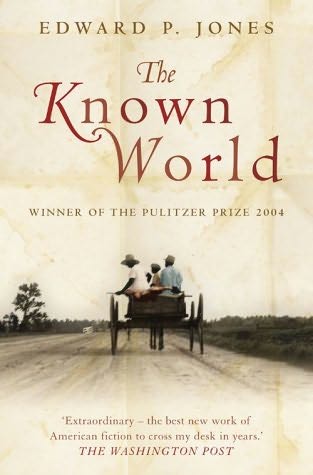
The Known World by Edward P. Jones (2003, 14 hrs. 13 min.): This was the Pulitzer Prize winner for 2004, and I've got to be honest, that's the only thing that kept me listening to the end. **CHEATER WARNING** Review from Amazon:
Set in Manchester County, Virginia, 20 years before the Civil War began, Edward P. Jones's debut novel, The Known World, is a masterpiece of overlapping plot lines, time shifts, and heartbreaking details of life under slavery. Caldonia Townsend is an educated black slaveowner, the widow of a well-loved young farmer named Henry, whose parents had bought their own freedom, and then freed their son, only to watch him buy himself a slave as soon as he had saved enough money. Although a fair and gentle master by the standards of the day, Henry Townsend had learned from former master about the proper distance to keep from one's property. After his death, his slaves wonder if Caldonia will free them. When she fails to do so, but instead breaches the code that keeps them separate from her, a little piece of Manchester County begins to unravel. Impossible to rush through, The Known World is a complex, beautifully written novel with a large cast of characters, rewarding the patient reader with unexpected connections, some reaching into the present day. --Regina Marler
The last sentence cracks me up. It's code for "boring and complicated, with too many characters to keep track of." I was patient, but didn't feel rewarded.
Rating: 3/5

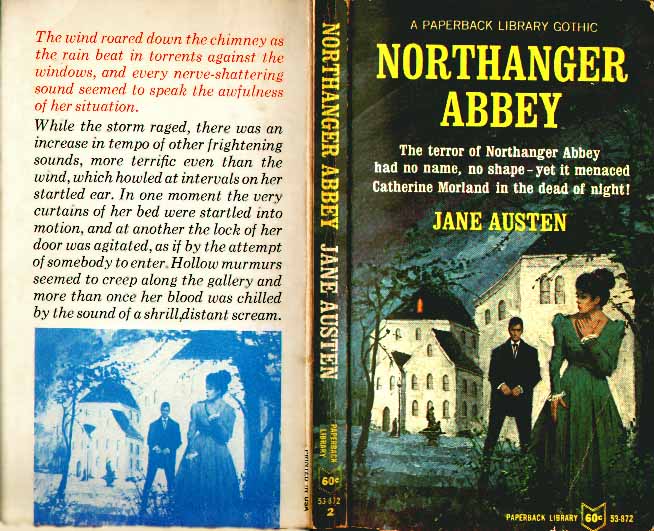
Northanger Abbey by Jane Austen (1798, 179 pgs.): This is the only Austen book I hadn't read, and the saying "save the best for last" does not apply here. Another expression that keeps popping into my head is "you can't win them all." Jane Austen is truly a genius, and in most of her works, her wit jumps out from every page, every sentence and every word. In Northanger Abbey, it just emerges every once in a while. I didn't hate it though--it is Jane Austen for heaven's sake! (Kind of like The Avengers is one of the lamest movies ever made, but Ralph Fiennes is in it, so I'll enjoy it anyway). Also, Catherine Morland reminded me so much of myself that it was scary--reads too much, bends her will to please others, and cries a lot.
I've watched about a third of the movie so far, and have learned that I have been pronouncing the title all wrong. It should be North-Anger--anger as in mad. But everyone likely knew that except for me.
Rating: 3.5/5

Uglies by Scott Westerfeld (2005, 448 pgs.): Here I can truly say that I have saved the best for last, (of my reviews, that is). I loved this one, showing that I will forever be a teenager at heart. Tally Youngblood lives in a world 300 or more years in the future, in which everyone is turned "pretty" at the age of 16 through a very thorough cosmetic operation. Tally learns of a small group of rebels who choose to live another way of life, rejecting the idea that everyone should be perfect. Fans of The Giver by Lois Lowry should love this one. My 13-year-old daughter loved it too and has read it twice, along with the rest in the series. (I should note that she was mortified that I wanted to read the same book as her. She couldn't find it for a couple of months, and I'm still not convinced that she didn't hide it on purpose.)
Rating: 5/5

Thank goodness I've gotten all of this off my chest and into the blogosphere. I can sleep without having nightmares about review-evasion agents coming to get me.

Tuesday, March 25, 2008

Video Review: Gossamer by Lois Lowry (2006, 3 hrs., 30 min.)

My children decided to do a talk-show format review of this one, having listened to it in the car. My plan was to edit out anything too goofy, but then it would have only been about 10 seconds long. So anyways, here it is--very unscripted, very silly, and hopefully somewhat informative:


Tuesday, March 4, 2008

The Golden Compass by Philip Pullman (1995, 10 hrs. 41 mi.)

Don't you just feel weird when you don't love a book that is raved about? After looking at the ratings on Amazon (1,078 people gave it five stars) and seeing it on a few top ten and top one-hundred lists, I just keep asking "Huh?" It is a very imaginative and original story about a girl named Lyra who is accompanied by her "daemon" Pantalaimon, a sort of separate manifestation of her soul that changes to different animals based on her emotions. She is a strong and courageous young girl, as well as rebellious and often dishonest, who is trying to rescue her friend Roger from "The Gobblers", a mysterious group of people who steal children. (That's just skimming the surface--the story is much more complex, with many unique characters and a beautiful setting.)
Despite the great writing and originality, I just didn't make any kind of connection with the story or the characters. There are definitely many layers to this novel, some of which have caused controversy for some religious groups due to the fact that the author is an atheist and is accused of trying to undermine Christian beliefs. All I can say is I read it, and I'm still going to church. Reading Harry Potter didn't get me into witchcraft either. But I do understand that literature can have a great impact on our beliefs and philosophies, and although this particular book in the series didn't seem too offensive to me, I probably wouldn't want my kids to read it without some discussion. And I definitely prefer the British title--Northern Lights. Doesn't that sound more intriguing than The Golden Compass?


Thursday, February 28, 2008

The Castle Corona by Sharon Creech (2007, 5 hrs.)

"Once there was a Castle, high on a hill,
and a King who longed for a nap
and a Queen who yearned for solitude
and a Prince who loved poetry
and a Princess who loved herself
and a Spare Prince who loved his sword
and a Hermit who was wise.

And there was a Village, down in the valley,
and a Peasant Girl who dreamed of flying
and a Peasant Boy who dreamed of horses
and a Master who dreamed of turnips
and an Old Woman who kept secrets."

Well, those verses pretty much cover this story, but of course I can ramble on a little more. This was a fable-like fairytale that was not wowish (surprisingly this is actually a word--no spell check underline), but homey. The story contrasts the lives of the inhabitants of the castle with two peasant children, Pia and Enzio, and how their lives come together due to a mysterious pouch that the children find and a couple of wise hermits. It is gently humorous at times and sprinkled with morals. I would suggest experiencing the actual book rather than listening to it as I did--after looking at the book at Amazon, I realized that there are beautiful illustrations that would make the story more enriching, and give it that medieval feel that all fairy tales deserve.

I must admit that I often view children's books mostly as tools to teach children values, and so that is often what I base my judgment on, more so than an exciting story. (Of course a good story helps put the lessons taught in an appealing package!) The Castle Corona touches on empathy, responsibility, and the power of imagination. It is one that I would read aloud to my children, with the beautiful illustrations to show.

Thursday, February 21, 2008

Four-Word Review:Sarah, Plain and Tall by Patricia MacLachlan (1985, 1 hr.)


Such a short story requires a short review--here it is in four (or kind of five) words:
Mail Order Sealed w/ Love

Tuesday, February 19, 2008

The Higher Power of Lucky by Susan Patron (2006, 3 hrs.)

In light of the controversy surrounding this Newbery pick of 2007, I'd like to add this subtitle: "The Curious Incident of the Dog with the Scrotum Bite." A story about a girl named Lucky living in the desert of California, and how she deals with growing up, losing her mother, knowing her father does not want her, and worrying that her guardian is going to leave her and move to Paris, gets overshadowed by the reference on page one of a dog's scrotum bitten by a rattlesnake. I have to admit, the first page caught me off guard, but more so because of the story surrounding the tragic (though insignificant) snake bite. I completely agree with Kristen McLean of Pixie Stix Kids Pix:

"I can’t help but notice with amusement that no one has objected to another passage in the first chapter of the book that involves a man “who had drunk half a gallon of rum listening to Johnny Cash all morning in his parked ‘62 Cadillac, then fallen out of the car when he saw a rattlesnake on the passenger seat…” Apparently rum, drunkenness, and poor taste in automobiles have nothing on scrotums when it comes to getting people in a moral outrage. (I can’t criticize the Johnny Cash. I love Johnny Cash.)"

I did wonder exactly what audience she was trying to reach. As a self-proclaimed quirkophile, I thought I would enjoy the quirkiness of the characters, but I found myself switching from the audio book to the radio a lot and waiting anxiously for the story to end. In a possible defense of the book, when I listen to books in the car, it is very fragmented. I have four kids who go to three different schools, and I do daycare a few times a week for kids who go to yet another school. So the story gets broken up into about six or seven five-minute segments throughout the day. I can't help but wonder if I would have appreciated it more if I had sat down and read it all at once. As far as children, I have no idea if it would hold their attention at all. My 11-year-old son, who only heard bits and pieces, just described it as "weird," but I think that was after hearing about how Lucky puts mineral oil on her eyebrows to make them "glisten."
Overall, I just wasn't that impressed, and although I'm not quite in agreement with the author: “The word is just so delicious. The sound of the word to Lucky is so evocative. It’s one of those words that’s so interesting because of the sound of the word,” the scrotum and the controversy were the only exciting aspects of this children's novel.

Wednesday, February 13, 2008

A Few Reviews

I've been a little busy lately (yesterday I was only able to read about 5 pages of a book--I'm having withdrawal symptoms!), so I 'll briefly review the books I have managed to read/listen to:

The Bourne Identity by Robert Ludlum(1980, 535 pgs.) - Intense and very entertaining to read. The only similarities between the book and the movie are the name and the idea of a man who gets amnesia. I love them both, but the book is (of course) better than the movie. I hadn't realized that it was written in 1980, so the technology is much different. I had a hard time putting it down, except at the end, when I had to take a break between chapters to take a few breaths.


The Wide Window
by Lemony Snicket (2000, 3 hrs.)
- Book 3 of the Series of Unfortunate Events. The Baudelaires end up with Aunt Josephine, who has many irrational fears, and reminds me a bit too much of myself! I don't have the right vocabulary to describe Lemony Snicket's writing style, but I love it. As a reader, I like being addressed, and I love his definitions (or connotations) of words and idioms. The author narrated this audio book, which was highly unpleasant for me. The second one was narrated by Tim Curry, which was great, so I don't know what possessed him to read for this one (and the fourth, which I will read the old-fashioned way!) I'm excited to move past Book 3 and into new material that wasn't covered in the movie.


The Good Mood Diet by Susan Kleiner (2007, 231 pgs.) - Sometimes I think I can never lose weight because then I wouldn't have a reason to read diet books! I have always been fascinated by food and how it affects you body, starting when I was about ten and read a book called Eat to Win. Unfortunately, I have not always eaten to win. I like the premise of this one, the focus is more on feeling good and fighting depression, and then weight loss usually follows. Not surprisingly, the foods that put you in a good mood are all of the latest foods spotlighted for good health: salmon, whole grains, veggies, etc. The author encourages eating enough food (yesterday I felt like I was eating all day long as I followed her plan!) and eating food in the right combinations--always having protein and fat with each meal and snack. To me that's kind of a pain and takes a lot of thought, but I'm trying it out. I like that she tells you to eat one whole egg everyday and end the day with hot cocoa (made with skim milk, unsweetened cocoa powder, and Splenda). Today is just the second day I'm trying it (and I am absolutely stuffed from breakfast). If I am actually successful at losing weight, maybe I'll do a follow-up review, but no one should hold their breath!


The Book Thief by Markus Zusack (2007, 550 pgs.) - This may seem blasphemous to the many fans of this book to not put this one on a pedestal and give it its own post! Despite its being buried in a multi-review post, it is a novel that sets itself apart with its originality and brilliance. Narrated by Death, who is almost reluctantly compassionate, it tells the story of Leisel Meminger, a German girl living with foster parents during the upheaval of World War II. Through the events of her life and her collection of stolen books, Death conveys the power of words, whether they are used for good or evil. Each time she steals a book, it's almost as if she is just taking back what it rightfully hers but has been taken away by the Nazis and Hitler. I felt like it was a very honest portrayal of what individual feelings and attitudes would have been at the time--no one is idealized and it is not overly sentimental, and yet it is emotionally powerful. Here's one of my favorite excerpts:

"On June 23, 1942, there was a group of French Jews in a German prison, on Polish soil. The first person I took was close to the door, his mind racing, then reduced to pacing, then slowing down, slowing down . . .
Please believe me when I tell you that I picked up each soul that day as if it were newly born. I even kissed a few weary, poisoned cheeks. I listened to their last gasping cries. Their vanishing words. I watched their love visions and freed them from their fear. . .
They were French, they were Jews, and they were you."

I should note that I started listening to the audiobook, which was excellently narrated, but in looking through the book, I realized that this is one you have to read, because there are a lot of visual elements to the story that enrich the experience. Although I have to admit, that without listening, I would not have know how to pronounce all of the German cuss words!


Well, it's back to life for me! I have been very lucky to have had so much time to read this past month or so, but I should have realized that was only temporary. I also have put on about five pounds, despite my reading of a couple of health books that would have me go in the other direction. In the past I have stepped up and down on my step while reading to get in some extra exercise--I'll have to try doing that again. I've considered giving myself a reading limit, maybe just 1-2 hours a day or a certain number of pages. But I would probably be just as successful with that as I am with limiting my food intake!

Tuesday, February 5, 2008

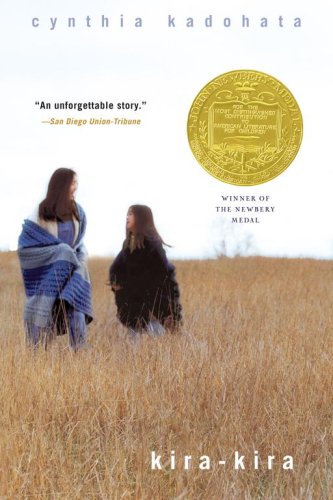
Audiobook: Kira-Kira by Cynthia Kadohata (2004; 4 hours, 29 min.)

From the back of the audio-case:

kira-kira (kee' ra kee' ra): glittering; shining

Glittering. That's how Katie Takeshima's sister, Lynn, makes everything seem. The sky is kira-kira because its color is deep but see-through at the same time. The sea is kira-kira for the same reason. And so are people's eyes. When Katie and her family move from a Japanese community in Iowa to the Deep South of Georgia, it's Lynn who explains to her why people stop them on the street to stare. And it's Lynn who, with her special way of viewing the world, teaches Katie to look beyond tomorrow. But when Lynn becomes desperately ill, and the whole family begins to fall apart, it is up to Katie to find a way to remind them all that there is always something glittering, kira-kira, in the future.

Luminous in its persistence of love and hope, Kira-Kira is Cynthia Kadohata's stunning debut in middle-grade fiction. Kira-Kira won the 2005 Newbery Medal for most distinguished American children's book.

I listened to this one in the car bit by bit during my various chauffeur duties. I liked the story, which is geared towards readers beyond sixth grade, I would say, but the reader sounded like she was reading to preschoolers, which bothered me. As far as the story, I liked that my kids could hear the struggles of this family and hopefully be grateful for the blessings they enjoy. Katie's parents work in a chicken factory many long hours, under undesirable conditions, to provide the necessities for their children. It's a tough life for them, especially dealing with Lynn's illness, and even though they live through some tragedy, Katie still comes through it all appreciating the simple beauties of life. It's not a page-turner (or whatever you would call it when it's an audiobook), but it definitely has it's merits, and where else are you going to hear Japanese-American characters speaking with a Southern twang?

Monday, January 28, 2008

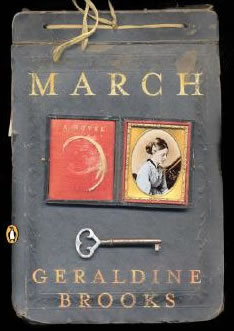
Audiobook: March by Geraldine Brooks (2005, 10 hrs. 22 min.)

In reading Little Women, I never really gave much thought to Mr. March and his experiences as a chaplain in the Civil War. (In fact, when I read it at a much younger age, I didn't even know it was during the Civil War!) This 2006 Pulitzer Prize winner gives us a chronicle of what his experiences might have been, and the realities of war that he does not write about in his letters home. A lot of his experiences are based on Louisa May Alcott's father, a transcendentalist who rubbed shoulders with Emerson and Thoreau. March encounters racism, both from Northerners and Southerners, and other cruelty that he struggles to take action against, but fails. We learn in flashbacks about his courtship with Marmee (and learn where Jo gets her temper from!) and why the family has become so poor.
The best word I can use to describe this "listen" is "interesting." It didn't grab me in any way, it was just "interesting" to see the different perspectives of various individuals and groups during the Civil War. I like to meet famous people in works of fiction and experience what a conversation with them would be like, and there are a few instances of this in this book. The books I love usually fit into one of two catergories--great storytelling or great writing. Occasionally a book fits into both. March didn't fit into either one for me, but I don't regret reading it, if that makes sense.

Tuesday, January 8, 2008

Audiobook: Snow Flower and the Secret Fan by Lisa See

This was a fascinating picture of life for women in China in the nineteenth century, as told by Lily when she is 80 years old reflecting back on her life. She lives in a world where women's feet determine their marriageability, relationships are contractual, women inhabit the "inner" sphere, while men dominate the outer, and where females are considered useless unless they bear sons. The main focus is her friendship with Snow Flower, and the secret fan on which they write the special women's language "nushu" (this may be spelled wrong, since I listened to rather than read the book.) As Lily goes through her life, she struggles with choosing between adhering to society's expectations of her or ignoring the many rules to maintain her friendship with Snow Flower, who has married into a family of lower social status. She also continually fails to accept Snow Flower for who she really is, with heartbreaking consequences. My review seems very inadequate, but let me assure you that the books is much better! It is very simply, but beautifully written. It also made me grateful to be living in this time and place. I have no desire to go through the painful process of having my feet bound so that they will resemble lilies and be admired by my husband. I'm sure he doesn't even know my shoe size!

Friday, December 28, 2007

Audiobook: The Amulet of Samarkand by Jonathan Stroud

This is the first in the Bartimaeus Trilogy, a series I had eyed at the library, but wasn't sure it was any good until I read a review at Bloggin' 'bout Books, and decided to give it a try. (I hope I am not breaking any blogging etiquette rules by linking to the review. If I am, sorry!)
At the risk of committing another faux pas, I have copied Wikipedia's plot summary. (I have read four books that I haven't reviewed yet, so I need to cheat a bit in the interest of time and housework.) :

"A magician's young apprentice, Nathaniel, secretly summons the irascible 5,000-year-old djinni, Bartimaeus, to do his bidding. The task for Bartimaeus is an interesting mission: he must steal the powerful Amulet of Samarkand from Simon Lovelace, a master magician of unrivalled ruthlessness and ambition. Before long, Bartimaeus and Nathaniel are caught up in a terrifying flood of magical intrigue, rebellion and murder. Nathaniel learns quickly that he may have gotten into a plot much more in depth than he and his djinni can cope with."

This was an awesome audiobook to listen to--the narrator was up there with the likes of Jim Dale of Harry Potter fame. He perfectly captured the fussy and sarcastic personality of Bartimaeus--his part was the strength of the novel. The narration is shared between first-person Bartimaeus, (who I could not help picturing played by Kelsey Grammar if a movie is ever made), and a third-person narrator (Hopefully I've gotten these terms right!). Another thing I loved about it was the comic use of footnotes. As a chronic digresser, I appreciated these. (And here I should digress and note that I started out reading the book and then switched to audio, where the footnotes are of course less obvious, but the humor not lost.)
I am looking forward to listening to the next in the series: The Golem's Eye, and hanging out with Bart a little more!

Wednesday, December 12, 2007

Audiobook: Angels and Demons by Dan Brown

Our public library has a fairly small selection of audio books, so when one looks even remotely interesting, I grab it. This one caught my eye, having read The Da Vinci Code, and enjoyed it very much (one of the very few books that actually kept me awake into the wee hours of the night). The Da Vinci Code was an adventurous choice for me. I was hesitant to read it because of the controversial content that seemed sacrilegious to me, but it was a book club selection, and I ended up not only thoroughly entertained, but also not really offended by much of the content, and fascinated by the treasure hunt aspect of it. So going into Angels and Demons, I hoped for more adventure, and was not too concerned about having any feathers ruffled.
It's holiday time, and my brain is somewhat fried, so I will be lazy and give you this review from Amazon that I think hits the nail on the head:

"Harvard symbologist Robert Langdon is shocked to find proof that the legendary secret society, the Illuminati--dedicated since the time of Galileo to promoting the interests of science and condemning the blind faith of Catholicism--is alive, well, and murderously active. Brilliant physicist Leonardo Vetra has been murdered, his eyes plucked out, and the society's ancient symbol branded upon his chest. His final discovery, antimatter, the most powerful and dangerous energy source known to man, has disappeared--only to be hidden somewhere beneath Vatican City on the eve of the election of a new pope. Langdon and Vittoria, Vetra's daughter and colleague, embark on a frantic hunt through the streets, churches, and catacombs of Rome, following a 400-year-old trail to the lair of the Illuminati, to prevent the incineration of civilization.

Brown seems as much juggler as author--there are lots and lots of balls in the air in this novel, yet Brown manages to hurl the reader headlong into an almost surreal suspension of disbelief. While the reader might wish for a little more sardonic humor from Langdon, and a little less bombastic philosophizing on the eternal conflict between religion and science, these are less fatal flaws than niggling annoyances--readers should have no trouble skimming past them and immersing themselves in a heck of a good read. "Brain candy" it may be, but my! It's tasty. --Kelly Flynn"

Definitely a lot of balls in the air! I also could have done without a few cheesy romantic scenes and a couple of disturbing sadistic situations. I felt like the author was pretty neutral in the battle between science and religion until the end, where I felt as though he depicted strong faith in God as fanatical madness. I can't even imagine how Catholics would feel reading about these characters who represent their religious leaders, and the diabolical or unconventional deeds they enact. Having said all that, Dan Brown is still a master storyteller, as evidenced by the fact that one can still enjoy such a far-fetched, over-the-top literary roller-coaster.