Wednesday, January 30, 2008

You: The Owner's Manual by Roizen and Oz (2005, 417 pgs.)

If only I could think of myself as an appliance (most appropriately a refrigerator), I know I would take care of myself just like the manual says to! At least that's what Roizen and Oz are getting at with this book. In each chapter, they explain the way each different system of the body works, and what can be done to keep up the maintenance of your body and live longer (and better). It is interesting stuff, told in understandable ways, with a bit of overkill on attempts at being humorous. There are lots of cartoonish illustrations, with cutesy names of anatomical parts that to me just adds confusion. (I was an anatomy tutor in college, but all that unused information has been stored deep, deep down in my brain, never to emerge--unless of course I eat the suggested foods and change up my routines regularly and all of the other advice in Chapter 3.) It is very down-to-earth health advice that I will try to follow. There is of course a diet and exercise plan at the end with some yummy sounding recipes. I'm just hesitant to add them to my ever-growing "recipes-to-try" list, that is almost, but not quite, as long as my books to-be-read list!


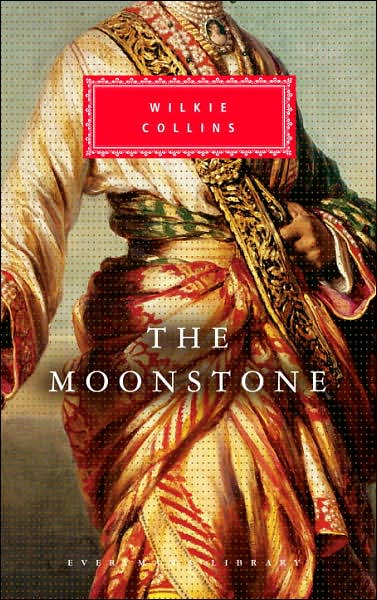
The Moonstone by Wilkie Collins (1868, 526 pgs.)

I had absolutely no idea what to expect from this novel; the only thing familiar to me was the name. Most surprising to me was how easy it was to read. It is basically a British detective story in which the Moonstone, a valuable diamond stolen from a sacred shrine in India, is given as a gift to Rachel Verinder, only to have it stolen from her. The plot unfolds very slowly at first, but is tolerable due to the comical voice of a couple of the narrators. The book consists of several letters written by the characters to sort out all of the events and evidence surrounding the theft in an effort to discover who is guilty. The first and funniest is Gabriel Betteredge, the head servant of the Verinder household, who uses his worn copy of Robinson Crusoe for inspiration and guidance.
He says:

"I have found it my friend in need in all the necessities of this mortal life. When my spirits are bad--Robinson Crusoe. When I want advice--Robinson Crusoe. In past times, when my wife plagued me--Robinson Crusoe. "

The second narrator, Mrs. Clack, the self-righteous cousin of Rachel Verinder, forces upon "perishing fellow creatures" her religious tracts--The Serpent at Home, Satan in the Hairbrush, Satan out of the Window, etc. She even goes so far as to deposit the tracts into Lady Verinder's flower pots, the bird cage, the piano, a fan, the bed--anywhere they might be discovered and lead to a much needed conversion. (I kept picturing Angela from The Office during her section.)

The following narrators were not nearly as entertaining, and the last 100 pages or so kind of dragged for me, but all in all I enjoyed it. It is considered the original modern detective story, if that's a draw for anyone. It's always fun to experience the birth of a genre!

Monday, January 28, 2008

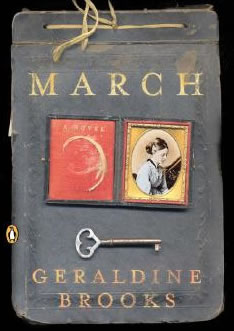
Audiobook: March by Geraldine Brooks (2005, 10 hrs. 22 min.)

In reading Little Women, I never really gave much thought to Mr. March and his experiences as a chaplain in the Civil War. (In fact, when I read it at a much younger age, I didn't even know it was during the Civil War!) This 2006 Pulitzer Prize winner gives us a chronicle of what his experiences might have been, and the realities of war that he does not write about in his letters home. A lot of his experiences are based on Louisa May Alcott's father, a transcendentalist who rubbed shoulders with Emerson and Thoreau. March encounters racism, both from Northerners and Southerners, and other cruelty that he struggles to take action against, but fails. We learn in flashbacks about his courtship with Marmee (and learn where Jo gets her temper from!) and why the family has become so poor.
The best word I can use to describe this "listen" is "interesting." It didn't grab me in any way, it was just "interesting" to see the different perspectives of various individuals and groups during the Civil War. I like to meet famous people in works of fiction and experience what a conversation with them would be like, and there are a few instances of this in this book. The books I love usually fit into one of two catergories--great storytelling or great writing. Occasionally a book fits into both. March didn't fit into either one for me, but I don't regret reading it, if that makes sense.

Friday, January 25, 2008

The Reading Meme That Took Me an Hour to Fill Out

Tagged by Susan of Bloggin' 'bout Books
Meme by Eva of A Striped Armchair

By the way, can anyone tell me where the word "meme" comes from? Is it short for something? Does it indicate "me" "me" because we answer questions about ourselves? I am clearly ignorant of some of this terminology! I just know they can be lots of fun!

Which book do you irrationally cringe away from reading, despite seeing only positive reviews?


Lolita by Nabokov. It's in the top ten of many "best" lists, and it's my local library's pick for the classic's book club in February, but I don't know if I could enjoy a book about an older man being obsessed with a young girl.

If you could bring three characters to life for a social event (afternoon tea, a night of clubbing, perhaps a world cruise), who would they be and what would the event be?

My idea of a social event is an evening at home! But who would I invite? Will Ladislaw of Middlemarch (dreamy!), Levin of Anna Karenina (we could really bond), and Snape of Harry Potter(to tell him I never doubted him, and perhaps suggest some good shampoo.)

(Borrowing shamelessly from the Thursday Next series by Jasper Fforde): You are told you can't die until you read the most boring novel on the planet. While this immortality is great for awhile, eventually you realize it's past time to die. What book would you expect to get you a nice grave?

Of Human Bondage by Maugham. I read 300-400 agonizing pages before I accepted the fact that I didn't need to torture myself any longer.


Come on, we've all been there. What book have you pretended, or at least hinted, that you've read, when in fact you've been nowhere near it?

Usually, it's the opposite for me--books that I'm embarrassed to admit I've read!

As an addition to the last question, has there been a book you really thought you had read only to realize when you read a review about it/go to "reread" it that you haven't? Which book?

My memory is so bad I can't remember one!

You're interviewing for the post of Official Book Advisor to some VIP (who's not a big reader). What's the first book you'd recommend and why? (If you feel like you have to know the person, go ahead and personalize the VIP)

To Kill A Mockingbird--to me one of the most perfect books every written.


A good fairy comes and grants you one wish: you will have perfect reading comprehension in the foreign language of your choice. Which language do you go with?

I don't know--I'm still trying for perfect reading comprehension in English! Other than that, I would pick Russian.

A mischevious fairy comes and says you must choose one book that you will reread once a year for the rest of your life (you can read other books as well). Which book would you pick?

That is a really hard question!! For a geeky answer I would say The Lord of the Rings. For mental health I would say Don't Sweat the Small Stuff, and It's All Small Stuff (I have anxiety issues!). For a hopelessly romantic answer I would say Jane Eyre. To keep my parenting in line I would say Parenting With Love and Logic.

I know the book blogging community, and all its challenges, have pushed my reading borders. What's one "bookish" thing you discovered from book blogging (maybe a new genre, or author, or new appreciation for cover art - anything)?

I have just been relieved to find out that there are others who are just as obsessed with books as I am! I have found that it is hard to resist reading challenges!

The good fairy is back for one final visit. Now, she's granting you your dream library! Describe it. Is everything leatherbound? Is it full of first edition hardcovers? Pristine trade paperbacks? Perhaps a few favorite authors have inscribed their works? Go ahead - let your imagination run free.

Well, as long as we're talking about fairies and magic, my dream library would go with me wherever I went, so that if I were waiting in line at the store, driving kids around, waiting at the doctor's office, I would have any book available at the snap of a finger. I would want access to any audiobooks, (currently I am at the mercy of what the library has.) I do have an irrational weakness for books that have the rough-edged pages. Is there a technical name for those? Sadly, I would have to admit that I would want a refrigerator in my library. And maybe a permanent chef. And I would want it to be soundproof.

Tuesday, January 22, 2008

The House on Mango Street by Sandra Cisneros (1984, 110 pgs.)

Esperanza, who hates her name because "it means sadness, it means waiting. It is like the number nine. A muddy color," tells us about her world after she moves into a new house in the Latino section of Chicago. It is a world filled with simple beauty and tragedy, and the usual aspects of a coming-of-age story, told in a spare yet poetic way. I feel like she captured the dreamlike memories of our youth that we have, where we remember more of the feelings and impact of the events than the main details. She introduces a whole cast of unique neighbors and friends that shape the environment that she sometimes wishes she didn't belong to. A quote from the back of the book describes it well: "A deeply moving novel. . . delightful and poignant. . . Like the best of poetry, it opens the windows of the heart without a wasted word." (Miami Herald)

Pictures of Hollis Woods by Patricia Reilly Giff

Hollis is an orphaned girl who gets bounced from one foster home to another, never quite feeling as if she belongs. She has a reputation for trouble, and usually ends up running. She is a very gifted artist, though, and when she moves in with the eccentric Josie, an elderly artist who is losing her memory, she learns not only the value and meaning of art, but starts to make sense of her fond memories and drawings of the Regan family that she ran away from the summer before.

Bottom line: It's a wonderful story that necessitates a Kleenex box nearby.

Thursday, January 17, 2008

As I Lay Dying by William Faulkner

I haven't done a four-word review in a while, so here's one for As I Lay Dying:

Dysfunctional Family Buries Mother

I can't quite leave it at that--I liked it better than The Sound and the Fury, but you still have to work at understanding some passages, and switch gears often due to the many narrators. In some parts I laughed, and others pondered the meaning of my existence, like the characters in the novel. If I were to read this in an American Lit class, where I would have to dissect it and dig deeper, I bet it would earn one more star. But for now: